Example: Sequential price competition
Consider the famous game of sequential price competition by Maskin and Tirole (1988).
There are two firms, each producing a homogeneous product at zero marginal cost. The two firms compete on price to maximize the net present value of profits given a common discount factor. Time runs in discrete periods and firms take turns to set their prices. In odd periods, firm 0 sets its price and firm 1’s price is locked in, and vice versa in even periods. Each period, firms face market demand \(d(p) = 2 - p\) which goes to the firm with the lowest price. In case of equal prices, demand is split evenly. Finally, firms choose prices from a grid \(P = \{0.0, 0.1, ..., 1.0, 1.1\}\).
The following assumes that the SGameSolver and NumPy packages
have been imported and that the game has been defined
as in Example: Stochastic game with sequential moves,
which also offers further information on the underlying state space.
import sgamesolver
import numpy as np

game = sgamesolver.SGame(...)
The price competition game has a vast multiplicity of equilibria, some featuring constant equilibrium prices and some featuring Edgeworth price cycles (with sequential undercutting and occasional resets).
Before searching the prior space, we need set the number of searches and initialize a container to keep track of the equilibrium strategies found by the solver.
runs = 100
strategies = np.zeros(shape=(runs, 24, 2, 11), dtype=np.float64)
Here, strategies is a 4D array with index
(run, state, player, action).
Random search
Performing the prior search, including a progress report, can be done as follows.
for run in range(runs):
    rho = game.random_strategy(seed=run)
    rho[np.isnan(rho)] = 0  # prior: transform NaN to 0
    homotopy = sgamesolver.homotopy.LogTracing(game, rho=rho)
    homotopy.solver_setup()
    homotopy.solver.verbose = 0  # make silent
    homotopy.solve()
    strategies[run] = homotopy.equilibrium.strategies.round(4)
    print(f"done run {run+1}/{runs}")
This should take around 30 minutes on an ordinary laptop.
We can plot the equilibria with
run = 0
plot_eq(strategies[run])
using the function plot_eq() defined as follows.
import matplotlib.pyplot as plt
from matplotlib.lines import Line2D
from matplotlib import gridspec

def plot_eq(strategy: np.ndarray, T: int = 30) -> plt.figure:

    # simulate price paths
    a_sim = np.zeros((T+1, num_players), dtype=np.int64)   # paths of actions

    # initial prices: firm 1: p_max, firm 2: p_max-p_step, ...
    for i in range(num_players):
        a_sim[0, i] = num_actions - 1 - i

    # simulation
    for t in range(T):
        a_sim[t+1, :] = a_sim[t, :]
        i = t % num_players
        a_not_i = np.delete(a_sim[t, :], i)
        s = get_stateID((i, a_not_i))
        # a_sim[t+1, i] = np.random.choice(range(num_prices), size=1, p=sigma[s, i, :])[0]  # random action
        a_sim[t+1, i] = np.argmax(np.random.multinomial(1, strategy[s, i, :]))  # most likely action
    p_sim = price_grid[a_sim]   # paths of prices

    # plot best responses and simulation of price paths
    fig = plt.figure(figsize=(12, 4))
    gs = gridspec.GridSpec(1, 2, width_ratios=[1, 1.8])

    # 1) best responses
    ax1 = fig.add_subplot(gs[0])
    ax1.set_title('Best Responses', fontsize=14)
    ax1.set_xlabel(r'$p_{2}(p_{1})$', fontsize=12)
    ax1.set_ylabel(r'$p_{1}(p_{2})$', fontsize=12)
    ax1.set_xlim(price_grid.min() - 0.1, price_grid.max() + 0.1)
    ax1.set_ylim(price_grid.min() - 0.1, price_grid.max() + 0.1)

    # grid
    ax1.hlines(price_grid, price_grid - 1, price_grid.max() + 1, colors='black', linestyles='dashed', lw=0.5, alpha=0.3)
    ax1.vlines(price_grid, price_grid - 1, price_grid.max() + 1, colors='black', linestyles='dashed', lw=0.5, alpha=0.3)

    # 45° line
    ax1.plot([price_grid.min() - 1, price_grid.max() + 1], [price_grid.min() - 1, price_grid.max() + 1],
            color='black', linestyle='dotted', lw=1, alpha=1)

    # firm 1
    for a2 in range(num_actions):
        for a1 in range(num_actions):
            ax1.plot(price_grid[a2], price_grid[a1], alpha=strategy[a2, 0, a1], linestyle='None', marker='o',
                    markerfacecolor='white', markeredgecolor='C0', markersize=6)
    # firm 2
    for a1 in range(num_actions):
        for a2 in range(num_actions):
            ax1.plot(price_grid[a2], price_grid[a1], alpha=strategy[num_actions+a1, 1, a2], linestyle='None',
                    marker='x', color='C1', markersize=6)

    ax1.legend(handles=[Line2D([0], [0], linestyle='None', marker='o', markerfacecolor='white', markeredgecolor='C0',
                            markersize=6, label='firm 1'),
                        Line2D([0], [0], linestyle='None', marker='x', color='C1', markersize=6, label='firm 2')],
            loc=(0.2, 0.75))

    # 2) price path simulation
    ax2 = fig.add_subplot(gs[1])
    ax2.set_title('Price Path Simulation', fontsize=14)
    ax2.set_xlabel(r'time $t$', fontsize=12)
    ax2.set_ylabel(r'price $p_{i,t}$', fontsize=12)
    ax2.set_xlim(-1, T+1)
    ax2.set_ylim(price_grid.min() - 0.1, price_grid.max() + 0.1)

    ax2.hlines(price_grid, -1, T+1, colors='black', linestyles='dashed', lw=0.5, alpha=0.3)
    ax2.vlines(range(0, T+1, 5), price_grid.min() - 1, price_grid.max() + 1, colors='black', linestyles='dashed',
            lw=0.5, alpha=0.3)

    ax2.hlines([marginal_costs], -1, T+1, colors='black', linestyles='solid', lw=1, alpha=1)
    ax2.text(T+1, marginal_costs, ' MC', horizontalalignment='left', verticalalignment='center')

    ax2.step(range(T+1), p_sim, where='post')

    plt.show()

    return fig
The resulting plot should be as in Fig. 5.
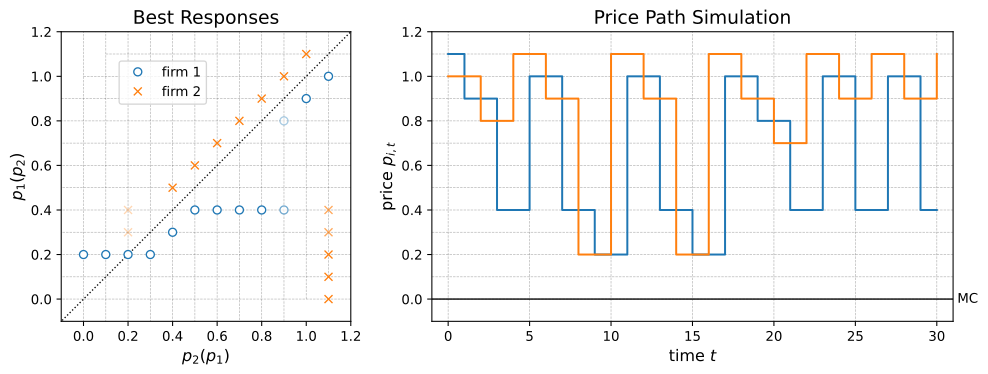
Fig. 5 Equilibrium in the sequential price competition game.
It shows best responses of both players as well as a simulation of the resulting price path. The price path simulation illustrates the famous Edgeworth price cycle pattern of sequential undercutting and occasional large price increases.